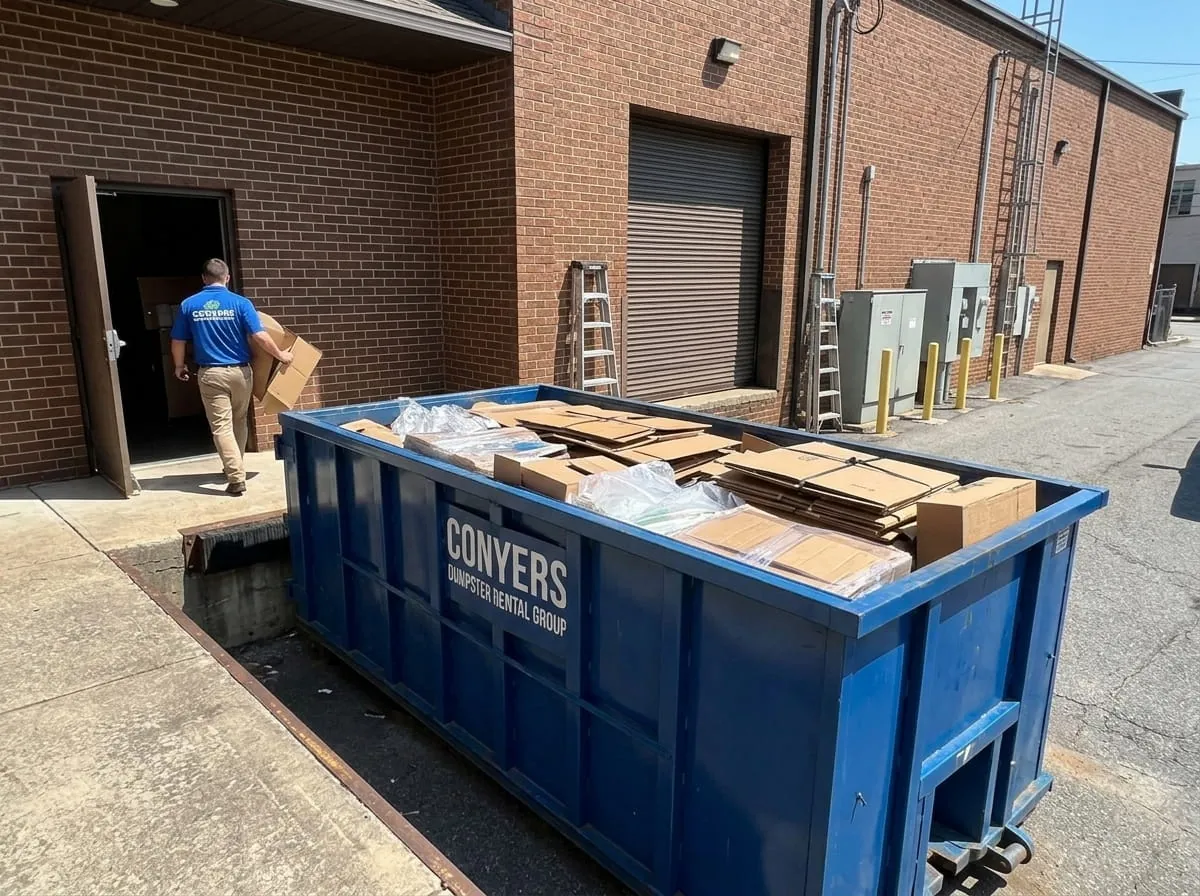
After a couple of decades dropping roll-off boxes across Rockdale County, I can tell you the single fastest way to blow a re-roof budget is renting the wrong dumpster for a tear-off. Roofing debris does not look like much sitting on a driveway, but pound for pound it is the heaviest material a homeowner will ever load. Get the size and the weight allowance wrong and the overage fee on the back end can cost more than the bin itself. This guide walks through the shingle-weight math, how to estimate your squares, when you are dealing with multiple layers, and how to protect your driveway while the crew strips the roof. It is written for Conyers and the wider Atlanta metro, where asphalt shingles, brutal summer humidity, and pop-up storms keep re-roofs running all season long.
Why Roofing Debris Is the Heaviest Load You Will Ever Rent For
Most people size a dumpster by volume, thinking in cubic yards. That works fine for a garage cleanout or a kitchen remodel, where you run out of space long before you run out of weight allowance. Roofing flips that logic on its head. A tear-off is dense, flat, and stacks tight, so you hit the weight limit while the box still looks half empty. Shingles are asphalt and mineral granule over a fiberglass or felt mat, and once you add the old underlayment, ridge caps, and a few thousand nails, the tonnage climbs fast. In humid Georgia heat, saturated felt and rain-soaked shingles get heavier still. That is why a seasoned operator will steer you toward a smaller, dedicated bin for roofing rather than the big 20 or 30 yard box you might picture for a construction job. The small box is not us being stingy on space; it is physics keeping your driveway and our truck axles safe.
The Shingle Weight Math: Bundles, Squares, and Tons
Roofers measure in squares. One square equals 100 square feet of roof surface. Shingles ship in bundles, and it takes about three bundles to cover a square for standard three-tab, sometimes three or four bundles for heavier architectural shingles. Here is where the weight sneaks up on you.
Three-Tab vs Architectural
Three-tab shingles, the flat single-layer style common on older Atlanta-metro homes, weigh roughly 230 to 250 pounds per square once torn off. Architectural, or dimensional, shingles, the thicker laminated style on most homes built or re-roofed in the last twenty years, run 400 to 430 pounds per square. That is nearly double. So the first question I ask a caller is not how big the roof is, but what kind of shingle is coming off, because the same size roof can produce twice the tonnage depending on the answer.
| Roof size | Three-tab, single layer | Architectural, single layer | Suggested bin |
|---|---|---|---|
| 10 squares | ~1.2 tons | ~2.1 tons | 10 yard |
| 15 squares | ~1.8 tons | ~3.2 tons | 10-15 yard |
| 20 squares | ~2.4 tons | ~4.2 tons | 15 yard |
| 25 squares | ~3.0 tons | ~5.3 tons | 15 yard |
| 30 squares | ~3.6 tons | ~6.3 tons | 15 yard plus weight allowance |
Those figures are for a single layer of dry shingles. Add underlayment, ridge vent, flashing, and rain, and I nudge every number up. Notice that a 30-square architectural roof can push past six tons. No 10 or 15 yard box is rated for that in one drop, which is exactly why the math matters before the truck rolls.
Estimating Your Roof Squares Before You Call
You do not need a roofer to get in the ballpark. Take your home footprint in square feet, then account for the pitch and overhangs. A simple ranch with a low slope might have roof area close to its floor area plus about fifteen percent. A steeper, cut-up roof with dormers and multiple facets can run thirty to forty percent more surface than the footprint suggests. Divide the total roof area by 100 to get squares. A 2,000 square foot Conyers ranch with a moderate pitch typically lands around 22 to 25 squares. If you already have a roofing estimate in hand, the contractor will list the squares right on it, which is the number you want to give us when you call. When you are unsure between two sizes, our team can talk it through; that is what the crew at our roofing dumpster rental service does all day.
Single Layer or Multiple Layers? The Atlanta-Metro Question
This is the one that catches folks off guard, and it is especially common on older homes around Conyers, Covington, and the east metro. Georgia code has historically allowed up to two layers of asphalt shingles before a full tear-off is required, so plenty of homes carry a second layer that was roofed over decades ago. When the crew strips a two-layer roof, you are throwing away double the material, which means double the weight. A 20-square roof that would be 2.4 tons as a single layer of three-tab becomes nearly five tons with two layers coming off. If your home was built before the 1990s and has never had a documented full tear-off, assume you might be dealing with two layers and size up your weight allowance accordingly. When in doubt, have your roofer lift a shingle at the eave and count the layers before you commit to a dumpster size.
Why a Smaller Dedicated Bin Beats a Big One
New customers often ask for the biggest box we have, figuring more room is safer. For roofing it is the opposite. A 10 or 15 yard roll-off has a lower wall height, which means your crew can pitch shingles in from ground level or off a ladder without hauling them up over a tall side. More important, the smaller box keeps you from overloading. If you put six tons of architectural shingles into a 20 yard box, the box is only two-thirds full but it is dangerously overweight; we may not be able to legally or safely haul it, and you are staring at a reload or a hefty overage. The 10 and 15 yard sizes are purpose-built for dense material. Take a look at our 10 yard dumpster for smaller single-layer jobs and the 15 yard dumpster for most full-home tear-offs; those two cover the vast majority of residential roofs in the county.
Nails, Underlayment, and the Rest of the Tear-Off
Shingles are only part of the load. A full tear-off also produces old felt or synthetic underlayment, drip edge, pipe boots, step and valley flashing, ridge caps, and a startling volume of nails. A single roof can shed thousands of nails, and they end up everywhere on the ground unless the crew is disciplined with magnetic sweepers. All of that debris goes in the roofing bin, and the underlayment in particular adds weight, especially when it has soaked up humidity or a passing thunderstorm. Do not toss anything but roofing material into a dedicated tear-off box; keeping it clean, all asphalt and roofing components, is what lets a disposal site take it as a single, priced-out load. Mixing in general trash or yard debris can change how the load is graded and billed.
Protecting Your Driveway During the Tear-Off
Two things threaten your driveway during a re-roof: the weight of a loaded box and the rain of debris and nails coming off the roof. A loaded roofing dumpster is one of the heaviest things that will ever sit on your concrete or asphalt, so we set the box on planks or boards to spread the load and prevent point-load cracking, particularly on hot Georgia afternoons when asphalt driveways soften. Beyond the box itself, tear-off debris and nails will litter the ground around the drop zone, so lay tarps and run a magnetic sweeper daily. We go deep on this in our guide on how to protect your driveway during a dumpster rental, and it is worth reading before the crew arrives.
Placement: Get the Box Under the Roofline
Placement makes or breaks the pace of a tear-off. You want the dumpster tucked as close to the roofline being stripped as the driveway allows, ideally right below the eave where the crew is working, so shingles can be pitched straight down into the box instead of carried across the yard. Talk with the roofing crew before drop day about which side of the house they are starting on, then have us position the box on that side. Leave the door end of the box accessible for loading the heavy bottom layer and for a final rake-out at cleanup. Keep the box clear of low power lines and overhanging branches, since our truck arm needs vertical clearance to set and retrieve it. A few minutes of planning here saves hours of hauling shingles across the property in the July heat.
Avoiding Overage Fees
Overage fees exist because a dumpster is priced with an included weight allowance, and roofing is the material most likely to blow past it. Three ways to stay clear: first, do the shingle math up front using the table above and be honest about layers, because a surprise second layer is the number one cause of overages on re-roofs. Second, match the bin to the tonnage, not just the volume; a 15 yard box with the right weight allowance beats a 20 yard box that tempts you to overload. Third, keep the load clean and level, and do not let debris mound over the rails, which makes the box unsafe and unhaulable. If your roof is large or you are stripping two layers of architectural shingle, it is often cheaper to plan for two hauls of a 15 yard box than to fight a single overloaded one. When you call, give us the squares, the shingle type, and the layer count, and we will size the weight allowance so the number you are quoted is the number you pay.
A Georgia Re-Roof, Start to Finish
Here is how a typical Conyers job runs. A summer storm lifts a few shingles, the homeowner books a roofer, and the roofer calls out 24 squares of aging architectural shingle, single layer. That is roughly five tons of tear-off. We drop a 15 yard box on planks the evening before, positioned under the main eave. The crew strips the roof the next morning, pitching shingles straight down, tarps and sweeps the driveway, dries the box in before the afternoon thunderstorm rolls through, and we haul it clean the day after. No overage, no cracked concrete, no nails in the tires. That is what right-sizing looks like. If you are planning a tear-off this season, call our team at (470) 276-5696 and we will help you land on the right box the first time.

Founder, Conyers Dumpster Rental Group — sharing straight advice from more than 15 years of local hauling experience.
Frequently Asked Questions
What size dumpster do I need for a roof tear-off in Conyers?
For most single-layer residential roofs, a 10 or 15 yard roll-off is the right call. A 10 yard box handles smaller roofs up to about 12 to 15 squares of three-tab, while a 15 yard box covers most full-home tear-offs. The deciding factor is weight, not space, so give us your roof squares, shingle type, and whether you have one or two layers coming off, and we will match the bin and weight allowance to your job.
How much does roofing debris weigh?
Torn-off three-tab shingles weigh roughly 230 to 250 pounds per square, and architectural shingles run 400 to 430 pounds per square, where one square equals 100 square feet of roof. A typical 24-square Conyers roof produces about three tons of three-tab or over five tons of architectural debris in a single layer. Underlayment, nails, and rain-soaked material push those numbers higher, which is why roofing is the densest load most homeowners ever rent for.
Why do you recommend a smaller dumpster for roofing instead of a big one?
Roofing debris is so dense that you hit the weight limit long before you fill the volume. A large 20 or 30 yard box tempts you to overload it, leaving it too heavy to legally or safely haul, which triggers a reload or an overage fee. A 10 or 15 yard box is purpose-built for dense material, has lower walls for easier loading, and keeps you within a predictable weight allowance.
How do I know if my Atlanta-metro home has multiple shingle layers?
Older homes around Conyers and the east metro often carry a second layer of asphalt shingles that was roofed over years ago, since Georgia code has historically allowed up to two layers. Have your roofer lift a shingle at the eave and count the layers before you order a dumpster. A second layer roughly doubles the tear-off weight, so knowing your layer count up front is the single best way to avoid a surprise overage fee.
How do I protect my driveway during a roofing tear-off?
A loaded roofing dumpster is extremely heavy, so we set the box on planks or boards to spread the load and prevent cracking, which matters most on hot Georgia days when asphalt driveways soften. During the tear-off, lay tarps in the drop zone and run a magnetic sweeper daily to catch the nails and debris raining off the roof. Positioning the box close under the eave also limits how far debris travels across your property.